
For many people with ADHD, organising information in multiple places isn’t just inefficient, it overloads a brain that already struggles with executive function, working memory, and attention regulation.
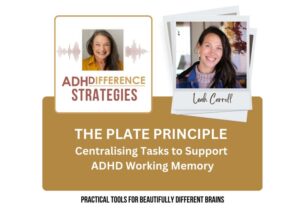 Leah, an ADHD coach and seasoned traveler, knows the power of simplicity. After years of trying to juggle her life across multiple to-do apps, journals, and mental notes, she learned that ADHD brains don’t need more tools, they need fewer. Her strategy?
Think of your tasks like emptying the dishwasher: you wouldn’t store your dinner plates in six different places. So why scatter your thoughts?
“Plates: they all go in their spot and they go in the same spot every time. You’re not randomly looking in all your cabinets for “Where did I put them?” It’s the same thing with our mental clutter. We’ve got to figure out one or two capture points.”
— Leah Carroll, ADHDifference
Why It Works
ADHDers often chase the “perfect” system and toggle between digital tools, paper planners, sticky notes, and the occasional voice memo… only to lose track entirely. But the real problem isn’t effort, it’s overload.
Scattered systems split your attention and tax your working memory. When you don’t know where your tasks live, the brain stays stuck in limbo. By committing to one central place (or maybe one or two), you reduce decision fatigue, increase visibility, and make it easier to trust your system.
When to Use It
- When you’re switching between multiple to-do apps, notes, or calendars and still feel like you’re forgetting things.
- When daily tasks feel disjointed, chaotic, or impossible to retrieve.
- When you catch yourself thinking “I wrote it down… but I have no idea where.”
How to Practice It
-
Pick Your One Place
Choose one system (notebook, notes app, or calenar for example). Make sure it’s something you enjoy using and can access easily. Don’t aim for perfect, aim for consistency. -
Centralise Everything Where Possible
Migrate scattered lists, sticky notes, and mental to-dos into this one system. (And if the brain insists on using sticky notes, just stick them inside your chosen notebook, diary or journal!) -
Create Rituals to Return
Check in daily. Even 2 minutes a day strengthens the habit and keeps your brain anchored to your trusted system. -
Resist the New Shiny Thing
Unless your system is truly not working, don’t switch apps every time you see a new one. Trust your setup. Edit within it, not around it.
The Science Behind It
For many people with ADHD, organising information in multiple places isn’t just inefficient, it overloads a brain that already struggles with executive function, working memory, and attention regulation. These cognitive processes are responsible for planning, holding information in mind, shifting between tasks, and remembering to act on intentions — all areas where ADHD brains typically show challenges.1
When ideas, tasks, or reminders are scattered across multiple lists, apps, and notes, the brain has to work harder to retrieve them, increasing mental effort and reducing follow‑through. Research on ADHD shows that these working memory difficulties are common and directly contribute to organisational struggles.2
When information and tools are gathered in a single, predictable location — whether a notebook, a whiteboard, or a central app — the brain doesn’t have to toggle between competing sources. This reduces cognitive load and supports more reliable task initiation and follow‑through.
💬 Final Thought
It’s not efficient to stack your dinner plates in random corners of the kitchen when one central shelf or cupboard makes sense. ADHD brains crave simplicity, not clutter, so a single or centralised place for your thoughts can turn chaos into clarity. When everything lands on one plate, you’re not just getting organised, you’re giving your brain a home base it can return to, again and again.
🎧 Listen to the full episode with Leah Carroll (S2E37) here 🎧
REFERENCES
- Kofler, M.J., Sarver, D.E., Harmon, S.L., Moltisanti, A., Aduen, P.A., Soto, E.F. & Ferretti, N. (2019). Working Memory and Organisational Skills Problems in ADHD
- Boone, D.R. (2023). What is Working Memory in ADHD?