
ADHDers often experience rejection sensitivity, low self-esteem, and a tendency to mask, all of which encourage self-suppression rather than self-expression. Taking up space is a form of psychological resilience and cognitive empowerment.
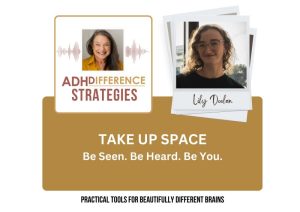 At just 19, Lily Doolan is already an outspoken leader in the neurodiversity space, recently appointed CEO of the Young Neurodiversity Champions in Aotearoa New Zealand. Her key strategy? Take up space. This is not just about visibility, it’s about self-worth, advocacy, and the radical act of showing up unapologetically.
For Lily, growing up undiagnosed with ADHD meant years of misunderstanding and anxiety, but her late diagnosis unlocked something deeper than relief, it offered permission. Permission to take up space in a world that often asked her to shrink.
“I think a really important mindset that I try to have every single day of my life is that I’m a person. I’m allowed to take up space — and I also have feelings.”
— Lily Doolan, ADHDifference
Her advice to others? Don’t wait for someone to invite you to belong. Step forward. Take up space. Your presence is valid. Your voice is needed.
Why This Strategy Matters
ADHDers often learn to shrink. Whether from social rejection, academic struggles, or masking in environments not built for us, the message is often perceived to be: Tone it down. Be less. Over time, this creates internalised beliefs that we are too much, or not enough.
This take-up-space strategy pushes against that. It gives ADHDers permission to:
- Occupy physical, emotional, and social space without apology
- Be assertive about their needs, perspectives, and energy
- Choose environments where they can show up fully
- Build confidence through visibility, even in imperfect moments
This isn’t about being loud. It’s about being real. It’s about belonging without shrinking.
When to Use This Strategy
Take up space when:
- You feel invisible or dismissed — especially in classrooms, workplaces, or social settings
- You’re tempted to mask or shrink your energy
- You’ve internalised feedback that your brain or behaviour is “too much”
- You’re navigating new environments (like university, work, or leadership roles)
- You want to lead or advocate — but fear judgement or rejection
In short: this strategy is for the moments when you need to remind yourself you deserve to be here.
How to Practice It Daily
The approach to taking up space is practical and personal. Here’s how to bring this into your own day-to-day:
- Claim Your Environment
Whether it’s a classroom, workspace, or social group, find ways to feel physically and emotionally present. Sit at the table. Speak up. Make eye contact. Don’t wait to be invited in. - Name Your Needs
Say what helps you thrive and what doesn’t. Ask for support, accommodations, or just space to think. Self-advocacy starts with clarity. - Reframe Rejection Sensitivity
Expect discomfort, not disapproval. It’s okay to feel awkward or vulnerable when you assert yourself. That doesn’t mean you’re doing it wrong, it means you’re growing. - Find Belonging in Brave Spaces
Seek out communities (like Young Neurodiversity Champions) where authenticity is celebrated. Safe spaces are good. Brave spaces are even better. - Use Your Voice
Whether in leadership, friendships, or daily life, use your voice to make space not just for yourself, but for others too. Advocacy begins with visibility.
The Science Behind It
Research shows that:
- Rejection Sensitivity Dysphoria (RSD) is common in ADHD and is associated with intense emotional responses to perceived rejection or criticism. Practicing self-advocacy and presence helps reduce internalised shame and build tolerance.1
- Masking, the act of hiding neurodivergent traits to “fit in”, is emotionally exhausting and linked to increased anxiety and burnout in ADHD and autistic populations. Taking up space reduces the need to mask.2
- Self-advocacy and visibility are linked to improved self-efficacy and reduced emotional dysregulation in ADHDers — particularly in academic and professional settings.3
Taking up space is not about ego, it’s about energy. It reduces the emotional load of hiding and invites the nervous system into safer, more congruent environments. When you are seen, your brain can stop scanning for danger and start thriving.
💬 Final Thought
Taking up space is a radical act of self-leadership especially for neurodivergent minds conditioned to be quiet, agreeable, or low-maintenance. Lily reminds us that being visible is not the same as being loud. It’s about choosing to exist fully in your study, your friendships, your advocacy, your leadership.
“Make sure that you are heard and seen and accepted in the place that you are being. And if it’s not doing it for you, then get out.”
— Lily Doolan, ADHDifference
You don’t have to wait to be ready. You don’t have to prove you belong. You already do. Take up space.
🎧 Listen to the full episode S2E20 with Lily Doolan here 🎧
REFERENCES
- Dodson, W. (2019). Rejection Sensitive Dysphoria and ADHD – How ADHD Ignites RSD: Meaning & Medication Solutions.
- Ai, W. Cunningham, W.A., Lai, M-C. (2024). Camouflaging, internalized stigma, and mental health in the general population.
- Karstensen, V. (2025). Predicting Adaptive Behavior by Self-Advocacy and Resilience in Adults with ADHD.