
Why Over-Engineering Productivity Can Erode ADHD Self-Trust
| with guest Dominic Carubba |
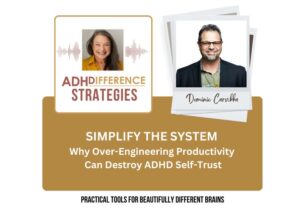 For Dominic Carubba (entrepreneur, ADHD coach, and former US Army officer) the biggest obstacle many ADHD adults face isn’t laziness, it’s over-complication. Many capable ADHD adults spend years trying to fix their productivity struggles by adding more tools, more planners, more apps, more strategies. Each new system brings hope.
But when the system inevitably becomes overwhelming or abandoned, the brain quietly records another piece of evidence: “See? I can’t trust myself.” Over time, those repeated cycles can slowly chip away at confidence. Dominic discovered that the real solution wasn’t finding a more sophisticated system. It was simplifying.
“If it works, use it. If it doesn’t, let it go.”
— Dominic Carubba, ADHDifference
Instead of adding layers of structure, many ADHD brains actually function better with less complexity and fewer moving parts.
Why It Works
ADHD brains often struggle with executive load — the mental effort required to plan, organise, track, and remember tasks. The more steps a system contains, the more executive effort it demands. Over time this creates friction.
A system designed to create order can ironically become another source of overwhelm. When a system fails, many ADHD adults assume the problem is personal discipline but often the real issue is simply too much structure to maintain.
Simplifying the system reduces cognitive load and allows the brain to focus on action rather than management.
When to Use It
This strategy is especially helpful if you notice yourself:
- constantly switching productivity tools or apps
- creating elaborate planning systems that don’t last
- feeling overwhelmed by your own organisation methods
- spending more time managing tasks than doing them
- believing you just haven’t found the “right system yet”
These patterns are common signals that the system has become more complicated than the work itself.
How to Practice It
-
Reduce the Number of Tools
Instead of using multiple apps, planners, trackers, and task managers, experiment with fewer tools. Often a single trusted place for tasks works better than several. -
Start With One Focus
Start by selecting one meaningful priority for a short period of time rather than trying to organise everything at once. This reduces overwhelm and restores forward motion. -
Let Systems Evolve
ADHD brains thrive with experimentation. Instead of searching for the perfect productivity structure, treat systems as temporary tools that can change over time. -
Track What Actually Works
Notice which systems you naturally return to. If something repeatedly helps you move forward, keep it. If it creates friction, simplify or remove it. -
Protect Self-Trust
Every abandoned system can feel like failure. But simplifying the process helps reduce those cycles and rebuild confidence in your ability to follow through.
The Science Behind It
Research shows that ADHD is associated with differences in executive functioning, particularly in working memory, planning, and task management systems. When systems require too many steps or sustained organisational effort, the brain’s executive resources can quickly become overloaded.
Cognitive Load Theory proposes that the brain’s working memory has a limited capacity for processing information at any given time. When too many elements, decisions, or steps are introduced simultaneously, cognitive load increases and performance can decline.¹
Research shows that tasks become more difficult when the mental effort required to manage the structure of the task exceeds the brain’s available working memory resources. Simplifying instructions, reducing unnecessary steps, and limiting competing information can therefore improve performance and learning.²
Because ADHD is associated with differences in executive functioning and working memory, complex systems that require constant organisation, tracking, or planning can quickly overload the brain’s cognitive capacity. Reducing complexity helps free up mental resources, making it easier to focus on the task itself rather than the system surrounding it.³
💬 Final Thought
Many ADHD adults spend years searching for the perfect productivity system. But sometimes the real solution isn’t finding a better system, it’s needing less system.
When tools become simple enough to use consistently, they stop being another obstacle. And that simplicity can slowly rebuild the thing many ADHD adults feel they’ve lost along the way: Self-trust.
🎧 Listen to the full episode with Dominic Carubba (S2E48) here 🎧
REFERENCES
- Sweller, J. (1988). Cognitive Load During Problem Solving: Effects on Learning
- Sweller, J., Ayres, P., & Kalyuga, S. (2011). Cognitive Load Theory
- Paas, F., Renkl, A., & Sweller, J. (2003). Cognitive Load Theory and Instructional Design