
Regulated parents create regulated environments. And that environment becomes one of the most powerful supports an ADHD child can have.
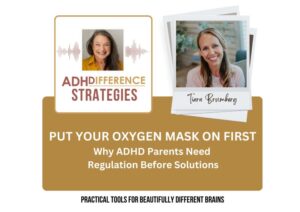 For ADHD parent coach Tiara Brumberg, one of the biggest traps parents fall into is tying their own emotional wellbeing to how their children are doing.
If the child is regulated, the parent feels calm. If the child is struggling, the parent feels overwhelmed, anxious, or like they’re failing. Over time, this creates a fragile emotional system where the parent’s stability rises and falls with every meltdown, school issue, or chaotic morning.
Tiara explains that this dynamic puts parents in a dangerous position, one where they can’t provide the stability their children actually need.
“We can’t be the caregivers we need to be. We can’t create the kind of safe home environment that they need to flourish if we are not doing okay.”
— Tiara Brumberg, ADHDifference
Instead, she suggests something simple… the same rule airlines give passengers: Put your own oxygen mask on first. Because a parent who is regulated, grounded, and supported is far better equipped to help a child navigate ADHD challenges.
Why It Works
Children, especially ADHD children, rely heavily on the emotional signals of the adults around them.
Neuroscience research shows that the nervous systems of caregivers and children are closely connected through a process known as co-regulation. When adults remain calm and emotionally steady, children are more likely to settle and regain control of their own emotions.
But when parents are overwhelmed, reactive, or exhausted, the household nervous system can escalate quickly.
Many ADHD parents unknowingly operate in a state of constant emotional vigilance — scanning for problems, anticipating meltdowns, worrying about school performance, or trying to prevent chaos. This state of chronic stress makes it much harder to respond thoughtfully to behaviour challenges.
Regulated parents create regulated environments. And that environment becomes one of the most powerful supports an ADHD child can have.
When to Use It
This strategy is especially helpful when you notice yourself:
- feeling emotionally drained by your child’s struggles
- believing your parenting success depends on how your child behaves that day
- reacting quickly with frustration or guilt
- feeling like you’re constantly “on edge” at home
- struggling to stay calm during meltdowns or conflict
These moments often signal that your own emotional oxygen mask needs attention first.
How to Practice It
-
Separate Your State From Your Child’s State
Your child’s behaviour may influence your day, but it doesn’t have to define your emotional stability.
Remind yourself: their regulation is not the measure of my success today. -
Stabilise Yourself First
Before responding to challenging behaviour, pause and check your own nervous system.
Simple resets can help: taking a few slow breaths, stepping into another room briefly, lowering your voice, slowing your body language.
Your calm becomes the emotional anchor of the moment. -
Reduce Emotional Contagion
Children often mirror the emotional energy in the room. If a parent escalates, the situation often escalates too. But when a parent stays grounded, it creates space for the child’s nervous system to settle. -
Build Your Own Support Systems
Putting your oxygen mask on first doesn’t mean doing everything alone.
It may involve: asking for help, building supportive routines, connecting with other ADHD parents and prioritising rest and personal wellbeing.
A supported parent is a more resilient parent. -
Accept Imperfect Days
ADHD households often include unpredictability. Not every day will feel calm or organised.
Putting your oxygen mask on first simply means remembering that your regulation is part of the solution, not something that comes after everything else is fixed.
The Science Behind It
Research consistently shows that parenting a child with ADHD can involve higher levels of stress and emotional strain than parenting neurotypical children. This is often linked to the child’s difficulties with emotional regulation and behavioural impulsivity.¹
This stress can create a feedback loop within the household. Research indicates that child ADHD symptoms can increase parental stress, while elevated parental stress can in turn affect family functioning and emotional dynamics.²
At the same time, emotional regulation develops through a process known as co-regulation, where caregivers help children return to emotional balance through calm and responsive interactions.³
Studies examining families of children with ADHD also show that parental emotional regulation plays an important role in parenting responses and child outcomes. When parents are better able to regulate their own emotional reactions, they are more likely to respond with supportive strategies rather than reactive ones.⁴
Taken together, this research highlights why stabilising the parent’s emotional state can be a powerful tool in ADHD households. A regulated parent helps create the conditions in which children can gradually develop their own regulation skills.
💬 Final Thought
ADHD parenting can sometimes feel like managing constant motion: big emotions, busy brains and unpredictable days.
But one of the most powerful things a parent can offer isn’t the perfect routine, the perfect strategy, or the perfect response. It’s stability. When you put your oxygen mask on first, you give your child something incredibly valuable: A calm nervous system to borrow from.
🎧 Listen to the full episode with Tiara Brumberg (S2E49) here 🎧
REFERENCES
- Theule, J., Wiener, J., Tannock, R. & Jenkins, J.M. (2013). Parenting Stress in Families of Children with ADHD A Meta-Analysis
- Jongrakthanakij, N., Prachason, T., Limsuwan, N., Kiatrungrit, K., Thongpan, M., Lorterapong, P., Wisajun, P. & Jullagate, S. (2026). From ADHD Symptoms to Parental Stress: The Roles of Functional Impairment, Family Functioning & Parental ADHD
- Paley, B. & Hajal, N.J. (2022). Conceptualizing Emotion Regulation and Coregulation as Family-Level Phenomena
- Tsahor, N.G. & Gray, S.A.O. (2020). Parental Emotion Regulation and Mentalization in Families of Children With ADHD